Technical
CMYK multi-material 3D printing: how it actually works
CMYK multi-material 3D printing blends four filaments into a fine halftone grid to deliver gradients and detail where classic 3D can only show a flat color. A jargon-free deep dive.
- #3D printing
- #CMYK
- #multi-material
- #filament
- #PLA
- #halftone
The color problem in 3D
A standard 3D printer extrudes a single filament at a time. You get a part in blue, or red, or white — but a single solid color. To do better, the industry invented two families of solutions: color powder inkjet printing (expensive, fragile, mostly used for architectural mockups) and multi-filament printing (a setup where several spools feed the same printhead).
Standard multi-filament gives you flat areas, logos, stripes: red here, blue there, black on top. But how do you reproduce a gradient? A photo? A face? That's where CMYK halftone comes in.
The principle: four filaments, one halftone grid
CMYK is the subtractive color system used by every paper printer: cyan, magenta, yellow, and black. In 3D printing, black is often replaced by white or a fourth filament chosen for the target palette.
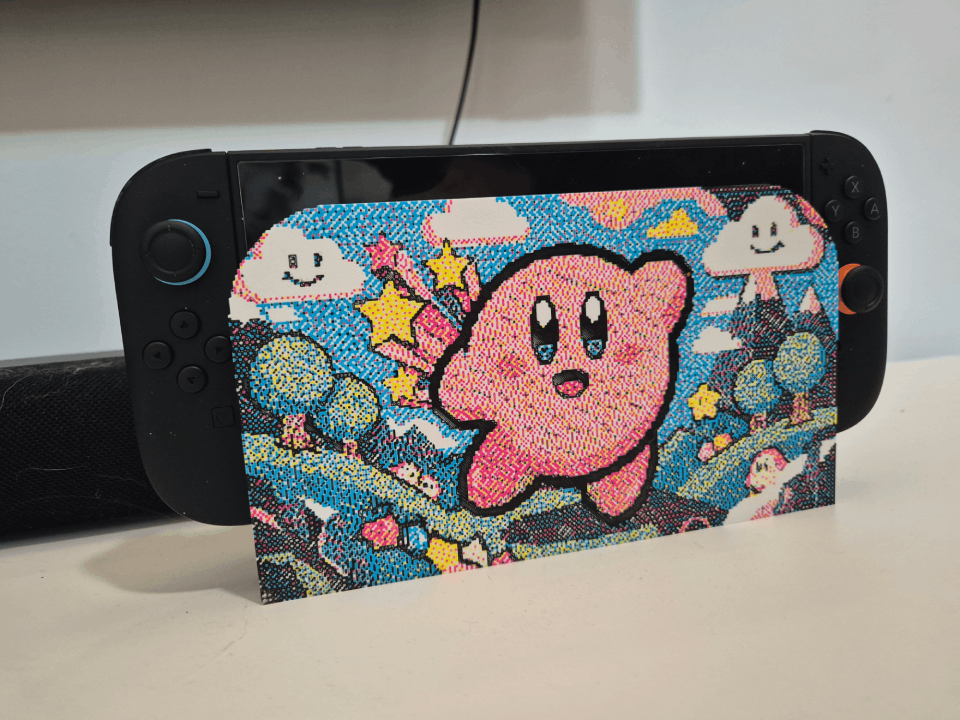
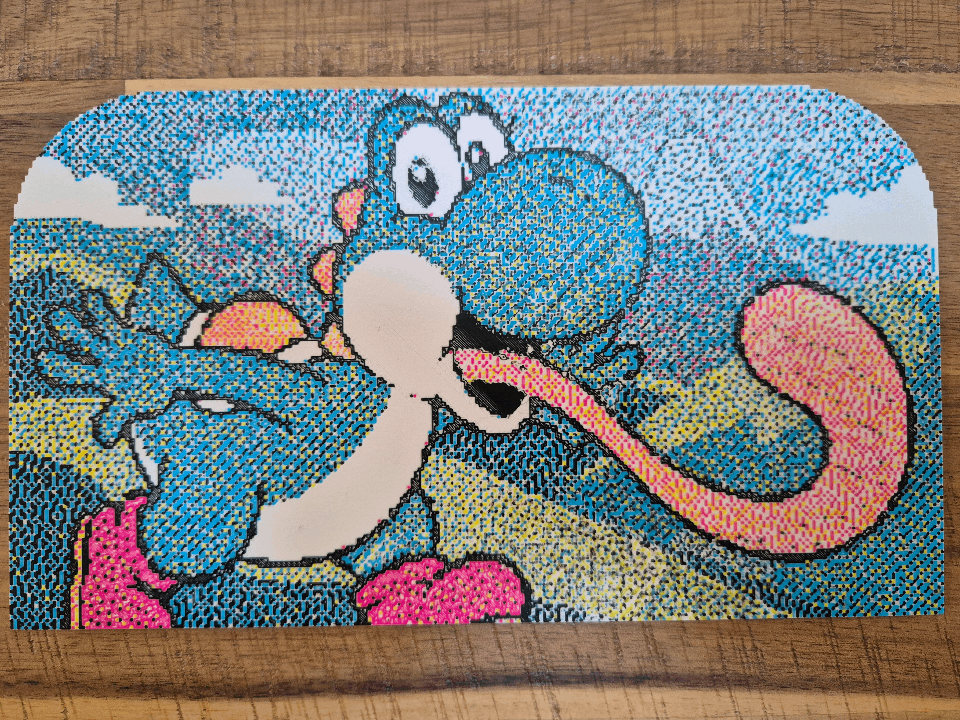
Rather than blending colors (impossible with solid plastic), the machine places fine dots next to each other. From a distance, the eye no longer sees individual dots: it sees a blend. A cyan dot next to a yellow dot reads as green. A dense zone of magenta and yellow reads as orange-red. The finer the grid, the more readable the image.
It's exactly the offset or screen-printing process: look at a magazine page very closely and you'll see the dots; step back a meter and the image smooths out.
The look: between pixel art and matter
The visual effect is distinctive: it's neither a smooth photo nor square pixel art. It's living matter, where you can see the grain when getting close. The result works particularly well for:
- landscapes and natural scenes with organic gradients;
- abstract, geometric, and neon mood compositions;
- stylized portraits, pop art, manga illustration;
- high-contrast compositions with a clean reading.
Conversely, dense compositions packed with micro-details and tiny readable text yield messier results. The Studio's Simplified mode generates visuals better suited to halftone printing.
Durability and longevity
The key advantage: color is part of the matter itself. No varnish that peels, no ink that fades, no sublimation to forget under the sun. The PLA used is a stable plant-based polymer, scratch- and impact-resistant within reason. A plate stored in a drawer keeps its look for years.
Avoid: leaving the part in a car under direct summer sun. PLA softens around 60 °C — like every consumer plastic.
Optimizing artwork for CMYK
- Embrace contrast. A well-contrasted image with crisp areas prints better than a flat gray-on-gray.
- Limit micro-text. Below a certain size the halftone eats fine details. If text must appear, make it large with breathing room.
- Think in blocks, not pixels. The process is an optical mix; it favors dense color zones over scattered detail.
- Use Simplified mode. It generates clean compositions that exploit the CMYK palette better.
Try it in practice
The best way to grasp the look is to generate a design and rotate it in 3D in your browser. The KoverSmith Studio shows the CMYK projection before printing — you know exactly what you'll receive.
To see how this technique fits the final product, see our complete guide to custom Switch 2 covers.
FAQ
Frequently asked questions
What exactly is CMYK 3D printing?
How is it different from standard 3D printing?
Is the result pixel-faithful to the source image?
What's the maximum number of colors?
How durable is PLA?
Take action
Design your custom Switch 2 cover now
Describe your idea, our AI generates the artwork and we 3D-print your Nintendo Switch 2 cover in CMYK multicolor. €9 per cover, €14 for the magnetic base.
Open the StudioRead next
Guides
Custom Switch 2 cover: the complete guide to customizing your TV dock (2026)
Your Switch 2 TV dock sits plugged into your living room 24/7 — it's the most visible piece of your gaming setup. Here's how to dress it with magnetic custom plates, with no skin, no glue, and the freedom to swap designs in a second.
Comparisons
Magnetic plate vs vinyl skin vs hard shell: which is right for your Switch 2 dock?
Three families of options to dress the Switch 2 TV dock. We compare cost over time, modularity, print quality and impact on the device.